
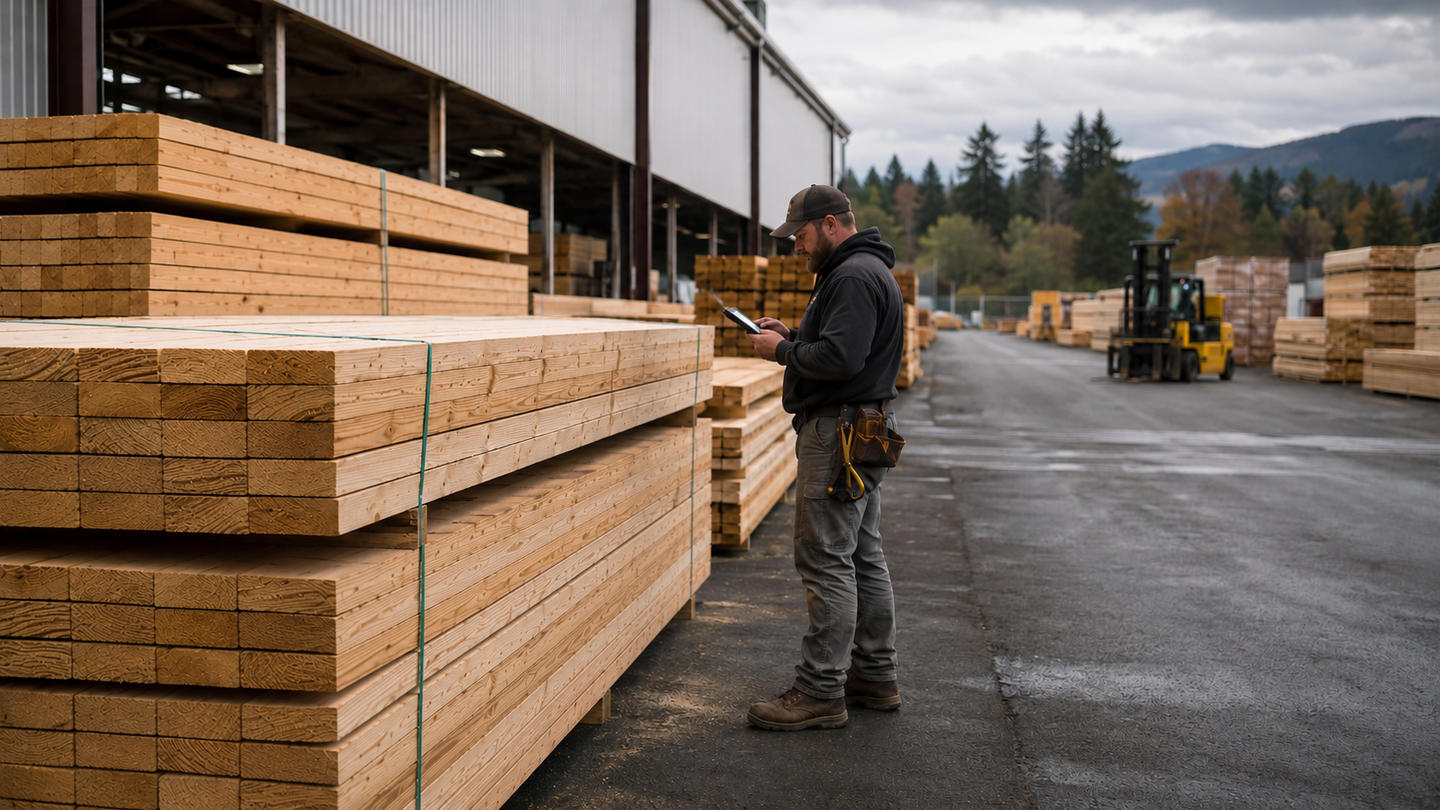
 What real unit-of-measure handling in lumber software requiresLumber is sometimes purchased in cubic meters, received and tracked by board feet, and sold by lineal feet or per piece. The software has to convert cleanly between all of them in real time, carry the attributes that define the product at every step (species, grade, size, length, surfacing, treatment), and record the tally detail that makes each transaction accurate. A system that holds one unit of measure per item is not lumber software. It is generic inventory software that will fight you every day.
Units of Measure in Lumber Software: Why One Unit Is Never Just One Unit
A unit of measure in lumber is not a fixed thing.
The same kiln-dried 2x4x8 can be purchased in cubic meters, received and inventoried by board feet, sold by lineal feet or per piece, and counted by the unit on a cycle count. It can leave the yard as part of a full pack, a partial pack pull, a mixed pull, or broken down to piece-level. At every step, the unit changes, the conversion has to be accurate, and the tally has to follow the product through every transaction.
Generic inventory software handles one unit of measure per item. You pick the unit when you set up the item, and that is the unit everywhere: on the purchase order, in stock, on the invoice. For a widget that is bought by the each and sold by the each, that works fine.
For lumber, it breaks constantly. The conversion math lands on the person at the keyboard, which means it is slow, inconsistently applied, and wrong often enough to cost real money. Unit-of-measure handling is not a feature category to check off on a vendor questionnaire. It is the core test of whether generic software can run a lumber business.
This article explains what real unit-of-measure handling requires, what generic systems get wrong, what to demand from lumber software, and how RDB Solutions’ two platforms handle this problem. If you are still in the early stages of evaluating your options, our lumber inventory software guide and how to choose ERP software for your lumber business are good starting points.
How Lumber Actually Moves Through Units of Measure
To understand why this is hard, let’s follow a single item through a typical lumber transaction.
A lumberyard purchases a load of Doug Fir 2×4 random lengths from a mill. The purchase order is in cubic meters, because that is how the mill prices it. The truck arrives, tallies are received in board feet, as that is how the yard tracks stock. The load goes into inventory as board feet, assigned by species (Douglas Fir), grade (No. 2 and Better), dimension (2×4), and length range (random 8 to 20 feet). A salesperson quotes a customer in lineal feet, because that is how the customer buys. The invoice goes out in lineal feet. The customer picks up a partial pack, and the remainder goes back into stock.
That is one transaction, and it moved through three units of measure: cubic meters, board feet, and lineal feet. Every conversion between those units has to be exact. Any system that forces a human to do the conversion manually is a system that will likely produce incorrect inventory counts, incorrect billing, and incorrect margin calculations, every day, on every transaction.
Why Generic Inventory Software Fails on Units of Measure
Generic inventory software was designed around the assumption that one item equals one unit of measure. Set it up once at item creation, and every transaction in the system uses that unit. That model works for most products. Lumber is not most products.
The first problem is the conversion gap. When a purchase comes in as cubic meters and inventory is tracked by board feet, the system cannot make that conversion. The receiver does it manually, notes it somewhere, and hopes the number carries through to the ledger correctly. Multiply that across a day’s worth of receipts, and you have a meaningful amount of untracked calculations.
The second problem is sales and invoicing. A salesperson who needs to quote in lineal feet on inventory tracked by board feet is doing unit math at the keyboard. If the conversion is off by a small percentage on a large order, the margin on that deal is wrong before the quote leaves the building.
The third problem is partial pulls. When a customer buys part of a pack, the system has to reduce inventory at the correct piece count and footage, which can mean splitting a unit of lumber. Generic systems treat this as an exception and require a manual inventory adjustment. In a lumber yard, it can be a daily event.
The fourth problem is tally detail. Tally captures the actual piece count, length mix, and board foot calculation at each touchpoint. Generic systems have no home for this. The tally often ends up in a spreadsheet next to the system, and the connection between what was tallied and what posted to inventory is a manual bridge that breaks whenever someone is out sick or does not follow the procedure.
What Real Unit-of-Measure Handling Requires in Lumber Software
Purpose-built lumber software treats unit-of-measure conversion as a core function, not a workaround. Here is what that looks like in practice.
Multiple Units Per Item, Converted in Real Time
Every item in the system should support as many units of measure as the product requires, with conversion factors defined at the item level. A Doug Fir 2×4 random length has a board foot factor. The system uses it automatically: enter a purchase order in cubic meters, the system converts to board feet and posts inventory in board feet. Enter a quote in lineal feet, the system converts from board feet and returns the correct price and quantity. No calculator. No spreadsheet formula. No one in the office who has been doing this long enough to have it memorized.
Ask any lumber software vendor to demonstrate a three-unit-of-measure transaction from purchase to sale, live, using a real item. The demo will tell you whether the conversion is native or a workaround.
Tally Detail Captured Through Every Transaction
Tally is how lumber is counted: piece by piece, with lengths and board feet calculated per piece and summed. Mill tallies and receiving tallies don’t always match. When they differ, the variance has to be reconciled with the mill before receiving into inventory, because the mill’s invoice is based on their tally count. The system has to capture both tallies, surface the variance, and hold the receipt until that reconciliation is done. Posting inventory before the tally is settled means your inventory and your payables are based on different numbers.
Lumber software should capture tally at the point of receipt, support both pack-level and piece-level detail, and carry the tally through sales and dispatch so the outbound count matches the physical load. The tally is the system’s source of truth on what is actually on the yard.
Full Attribute Tracking on Every Item
A unit of measure without attributes is not enough. Two truckloads of 2x4x8 can be the same dimension and grade but different species, different surfacing, different treatment, and priced differently for the same customer. The system has to track species, grade, size, length, surfacing, and treatment as first-class searchable fields, not as custom text fields that inventory reports ignore.
When a salesperson searches for available 2×4 stock, they need to be able to filter by species and grade, not just see a total board foot count that mixes everything together.
Partial Pack Pulls Without Workarounds
When a customer buys part of a pack and the rest stays in the yard, the system should handle that as two transactions on one source pack: break the unit into pieces and ship only what the customer ordered, with no manual inventory adjustment required. The unit math resolves inside the transactions.
Ask vendors specifically how the system handles a partial pull and a subsequent partial pull from the same source pack. If the answer involves creating a new item record or manually transferring inventory to a new location, the system is not handling this natively.
Inventory Expert vs. Lumber Expert: Which Path Fits the Operation
RDB Solutions builds two purpose-built platforms for the lumber industry. Both handle unit-of-measure conversion, tally detail, and attribute tracking natively. The difference is scope.
Inventory Expert is the focused platform. It covers purchasing, sales orders, and dispatch natively. It is the right call for operations that want lumber-ready inventory and order management without committing to a full ERP install. Accounting stays where it is, and Inventory Expert handles the lumber-specific work it was built to do.
Lumber Expert is the integrated ERP. It adds lumber-specific accounting and multi-entity consolidation on top of everything Inventory Expert does, running inventory, purchasing, sales, dispatch, and the general ledger on one database. It is the right call when the business needs a single source of truth across the full operation, or when inventory, dispatch, and accounting need to run on the same transaction without integration gaps.
Both platforms convert between units of measure in real time, capture tally detail at every touchpoint, and carry full product attributes from receipt to invoice. The decision between them is about accounting and consolidation complexity, not about whether unit-of-measure handling works.
The Questions to Ask Every Lumber Software Vendor on Units of Measure
Before any contract conversation, get specific answers on how the system handles units of measure. Generic answers are a signal the vendor is guessing.
- How many units of measure can be assigned to a single item, and how does the system convert between them in real time?
- Can you demonstrate a purchase in cubic meters converted to board feet inventory and sold in lineal feet, using a real item, in a live system?
- How does the system handle a partial pack pull, and what happens to the remainder in inventory?
- Does the system capture tallies at the point of receipt? At dispatch? How is variance between those two tallies recorded and audited?
- How does the system track species, grade, dimension, length, surfacing, and treatment, and are those attributes searchable and reportable in inventory and sales reporting?
- What happens when the same dimensional product from two different mills needs to be kept separate in inventory?
A vendor who cannot answer these in a live demo is a vendor whose system is not lumber-ready, regardless of what the marketing materials say.
Frequently Asked Questions
What does units of measure mean in lumber software?
Units of measure in lumber software refers to the different ways lumber is measured and transacted across a single item’s lifecycle. The same product can be purchased in cubic meters, inventoried by board feet, quoted and sold in lineal feet or per piece, and cycle-counted by unit. Lumber-ready software converts between all of those units automatically at every transaction point, without requiring manual calculation.
Why can’t generic inventory software handle lumber units of measure?
Generic inventory software assigns one unit of measure to each item at setup and uses that unit across every transaction. Lumber moves through multiple units of measure in a single transaction. When the system can only hold one, every conversion between units falls to the operator. Manual conversions are slow, inconsistently applied, and wrong often enough to produce real margin and billing errors at scale.
How does RDB Solutions handle multiple units of measure?
Both Lumber Expert and Inventory Expert support multiple units of measure per item with conversion factors defined at the item level. When a purchase order arrives in cubic meters, the system converts to board feet and posts inventory in board feet automatically. When a salesperson quotes in lineal feet, the system converts from board feet and returns the correct price and quantity. No manual conversion is required at any step.
What is tally detail and why does it matter in lumber software?
Tally detail is the piece-by-piece count of lumber at each transaction point: how many pieces, in what lengths, summing to what board foot total. Mill tallies, receiving tallies, and shipping tallies can differ. When a mill ships a load, they send an invoice with their tally attached. If the count at receiving differs from the mill’s tally, that discrepancy is reconciled with the mill before the load is posted to inventory. The mill may issue a corrected invoice. Lumber software records the reconciled tally at receipt and carries that detail through sales and dispatch so the outbound count matches the physical load. Generic systems have no home for tally data, so it ends up in spreadsheets alongside the system.
What is the difference between Inventory Expert and Lumber Expert for unit-of-measure handling?
Both platforms handle unit-of-measure conversion, tally detail, and attribute tracking in the same way. The difference is scope. Inventory Expert covers inventory, purchasing, sales orders, and dispatch without a built-in general ledger. Lumber Expert adds lumber-specific accounting and multi-entity consolidation. The unit-of-measure functionality is not the deciding factor between them.
Ready to See Unit-of-Measure Handling in a Live System
If you are evaluating lumber software, RDB Solutions will run a unit-of-measure demo on real lumber transactions, not a simplified version. We will show a purchase in cubic meters converting to board feet on receipt, a partial pack pull with the remainder going back into inventory, and an invoice in lineal feet on board-foot-tracked stock. Everything that generic software forces someone to calculate by hand, visible in a single transaction flow.
RDB Solutions has been building lumber software since 1993 from Bend, Oregon. Inventory Expert handles purchasing, sales orders, and dispatch with full unit-of-measure conversion built in. Lumber Expert adds accounting for operations that want inventory, purchasing, sales, dispatch, and the general ledger running on one system.
Schedule a conversation. Call 541-668-6360 or request a demo.
About the Author
Kevin Stanton is the founder of RDB Solutions, a lumber software company headquartered in Bend, Oregon. He founded RDB Solutions in 1993 after years in the lumber wholesale industry, where he recognized the gap between general-purpose business software and the realities of lumber operations. He leads product development on Lumber Expert, Inventory Expert, and Trader Expert.